Best Non GamStop Sites in 2026: The Complaints Route Is the Whole Story
 Available in US
The best non GamStop sites are offshore operators holding a Curaçao, Anjouan, Kahnawà:ke or Malta licence rather than a Gambling Commission one. None is licensed in Great Britain, none is part of Gamstop, and no British regulator or adjudicator decides a dispute with them. What separates a sound site from a bad one is the complaints route.

Non GamStop sites exist because Gamstop does not. Since 31 March 2020 every online operator holding a Gambling Commission licence must participate in the national multi-operator self-exclusion scheme — the requirement sits in social responsibility code provision 3.5.5, and in April 2020 the Commission suspended the licences of two operators for missing the deadline. Sites outside that licence have no such obligation.
Note the name first. Gamstop is often typed “gamestop”, and the slip is now common enough that the scheme’s own rebrand in November 2025 — Gamstop Online, with the betting-shop scheme formerly called MOSES becoming Gamstop Betting Shops — has not dislodged it. The spelling matters here for a duller reason: it is the same instinct that makes a player skim a licence page. A scheme that holds 614,738 people on its register as of July 2026 is not a technicality to be worked around.
I have covered this market long enough to know that the argument for offshore play is rarely about bonuses. It is about being blocked. And that is exactly why the complaints question should come before the welcome offer: on a British-licensed site there is a statutory ladder, and on an offshore site there is only whatever the licence authority has written down.
What “Non GamStop” Actually Means in 2026
A site described as non GamStop is one that does not check the register because it is not required to. Gamstop Online blocks a person from signing up for or using accounts with gambling companies licensed in Great Britain. It cannot touch anyone else. Gamstop states on its own pages that it can only exclude from participating operators and is unable to prevent access to services run by organisations that do not participate.
The legal baseline is worth stating plainly, because affiliate copy tends to blur it. Section 33 of the Gambling Act 2005 makes it an offence to provide facilities for gambling without an operating licence, and it is immaterial whether the facilities are provided wholly or partly by remote communication, or inside or outside the UK. The Act is enforced against the provider, not the customer. The Gambling Commission says flatly that it is illegal to offer commercial gambling services to consumers in Great Britain without a Commission licence, including where the operator holds a licence somewhere else.
Two consequences follow. First, offshore sites are not licensed in Great Britain, so UK protections do not apply: no statutory self-exclusion backstop, no Commission complaints process, no approved alternative dispute resolution provider obliged to take the case. Second, an offshore site is never a way round a self-exclusion. A Gamstop registration holds for its full term — six months, one year, five years, or five years with auto-renewal — and then stays in place until the person contacts Gamstop to remove it. It cannot be cancelled during the period.
Where to get help: the National Gambling Helpline, run by GamCare, is free on 0808 8020 133, 24 hours a day, every day of the year. For callers in Wales the number given is 0808 2819 265. BeGambleAware is the public-facing brand of the charity GambleAware and directs people to the same helpline. GamFam supports families. Gamblers Anonymous England, Wales & Ulster runs a line on 0330 094 0322 with around 250 meeting locations.
Checking a Licence You Have Never Heard Of
The licences most often cited by sites accepting UK players are not equivalent, and the paperwork has changed recently enough that a stale claim is now a warning sign in itself.

Curaçao reformed in December 2024. The LOK took effect on 24 December 2024 and made the Curaçao Gaming Authority the direct licensing and supervisory authority, replacing the old master-licence and sub-licence model. The legacy “orange” sub-licence certificates of operation ended on 15 October 2025, and the CGA says a historic /JAZ number or legacy seal must not be treated as independent proof that an operator currently holds a valid licence. Licensing ceased for the four former master licensors between 18 August 2024 and 31 January 2025. Operators had provisional licences extended to 24 December 2025. There is a live verification problem: on 7 October 2026 the CGA said its previous online gaming portal would not return to service and that it is working on an alternative mechanism for verifying licensed domains, because the previous digital seal may be affected by the transition.
Anjouan is the licence of the moment, and the cheapest to talk about. The framework rests on legislation adopted in 2005, and the Anjouan Gaming Authority names the Anjouan Offshore Financial Authority as the competent authority, with Anjouan Licensing Services Inc. as sole authorised licence administrator. Fees are published: EUR 17,828 for B2C licence issuance, one-time, and the same for annual renewal, with EUR 500 per additional domain. An ABC News investigation published on 31 December 2025 reported that Anjouan Licensing Services claims to have issued more than 1,300 gambling licences at around EUR 17,000 each per year, and that a former attorney-general of the Comoros described the licensing entity as “an illegal entity”. Anjouan Gaming itself stated on 10 June 2026 that an Anjouan licence “is not, and has never been presented as, a universal authorisation to operate in every country in the world”. An independent legal opinion backing the authority’s validity, dated 19 September 2024 and reconfirmed in February 2026, comes from the licensee’s own statement and is not an official finding.
Kahnawà:ke is the oldest of them, regulating interactive gaming since 1999, with operators hosted at a data centre in the Mohawk Territory. Malta’s authority publishes a list of Unauthorised URLs and states it has no connection with those domains. Costa Rica, meanwhile, has no comprehensive gambling licensing regime at all: its Legislative Assembly rejected Bill No. 25,057 in early 2026, and the “data processing license” sometimes quoted in the trade is not a licence in the strict legal sense. A site resting on that has nothing to verify.
The Numbers That Decide Where a Complaint Ends
Payout behaviour is where offshore sites diverge most, and where the difference in governance shows. British-licensed sites are held to Commission data and Commission expectations. Offshore sites are held to their own terms.
The Commission’s figures for June to September 2024, cited in a speech delivered on 6 November 2025, record 44.2 million withdrawals by customers of large online operators: 96.3 per cent cleared automatically, 3.5 per cent within 24 hours and 0.1 per cent up to 48 hours. That is the benchmark. Reverse withdrawals have been banned outright for remote operators since 31 October 2021 under RTS 14B, which states that consumers must not be given the option to cancel a withdrawal request.
The table below compares the routes a player might use, and the numbers are the numbers in the text above and below.
| Route | Licence and rule that binds it | Typical clearing | Where a dispute ends |
|---|---|---|---|
| GB-licensed operator, e-wallet or card | Gambling Commission, LCCP | 96.3% automatic; 0.1% up to 48 hours | ADR entity, free, after 8 weeks or a deadlock letter |
| Curaçao-licensed operator | CGA under the LOK | Operator terms only | CGA licence conditions; no GB recourse |
| Anjouan-licensed operator | Anjouan Gaming, 2005 Act | Operator terms only | Authority-approved ADR provider, escalation after 30 days |
| Kahnawà:ke-licensed operator | KGC Regulations 1999 | Operator terms only | KGC Dispute Resolution Officer |
| Malta-licensed operator | MGA | Operator terms only | Malta complaints form; no GB recourse |
| Costa Rica, no licence | None | Operator terms only | Nothing outside the operator |
Two rules from the British side of the line are worth carrying into any comparison, because they show what “fair terms” means when it is written down. LCCP licence condition 17.1.1, in the version effective from 29 July 2026, says a customer’s request to withdraw must not result in a requirement for additional information if the licensee could reasonably have requested that information earlier — though that does not stop an operator seeking information it must obtain at that moment under anti-money-laundering rules. And there is no fixed maximum number of days in the LCCP within which a withdrawal must be completed; the regime leans on the fair-and-open condition 7.1.1, condition 17.1.1 and the prohibition on unfair terms.
The enforcement record shows where the pressure lands. On 21 October 2026 the Commission announced that one operator would pay £900,000 in a regulatory settlement for failures including unnecessarily delaying consumer withdrawals: a term allowing only one withdrawal request at a time was found unfair under the Consumer Rights Act 2015, and manual review of every fifth or tenth withdrawal for some customers led to extra information being demanded before payouts were processed. Withdrawal problems have been the number one topic raised by consumers with the Commission’s Contact Centre, and complaints coded “Withdrawals and/or financial transactions” fell from 2,416 in the year to December 2022 to 1,791 in the year to December 2025. The trend is good. The ordering of topics has not changed.
The Identity Check, Which Is Where Offshore Terms Bite
The single thing this topic turns on is when you are asked to prove who you are. On a British-licensed site that moment is regulated; offshore it is a contractual event, and the contract is written by the party that benefits from the delay.
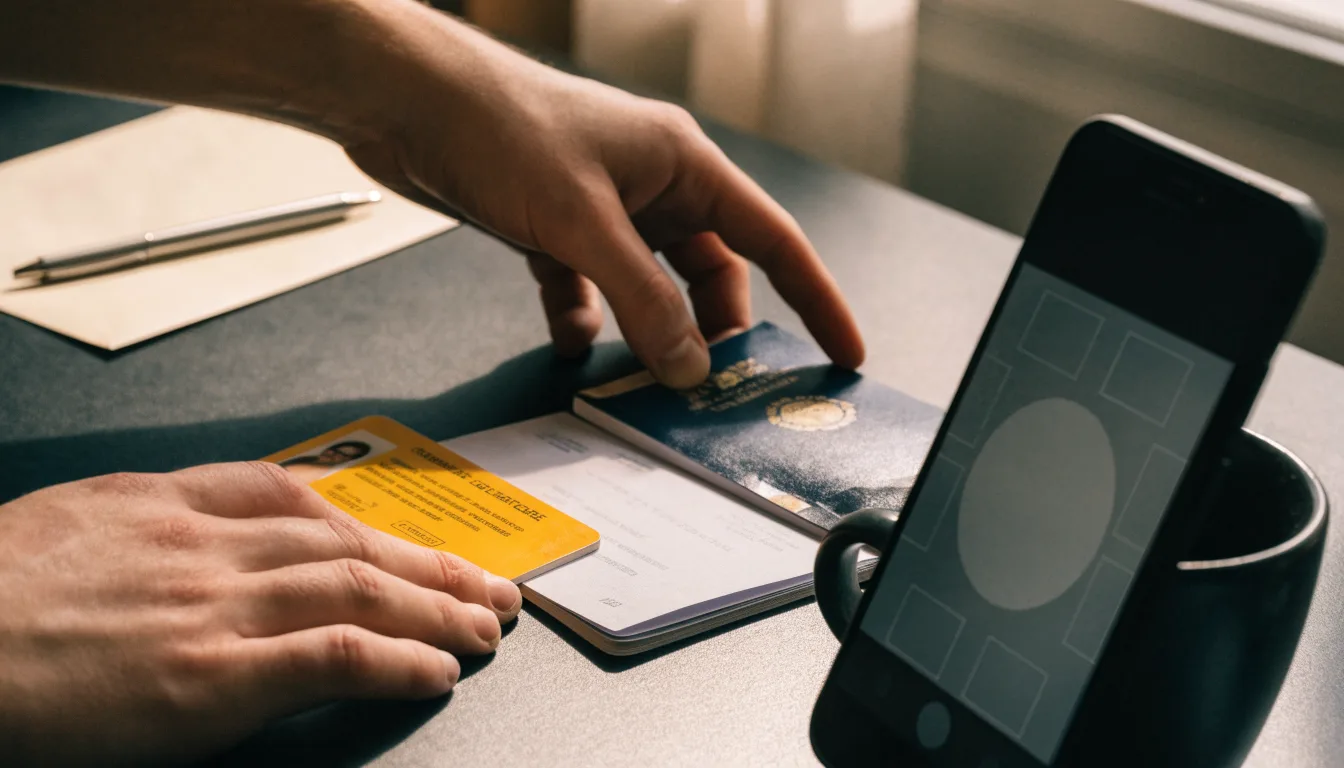
The British rule is Licence Condition 17, introduced on 7 May 2019, requiring licensees to obtain and verify information establishing a customer’s identity before that customer is permitted to gamble, covering at least name, address and date of birth. The anti-money-laundering regulations set a separate threshold: in remote casinos, identification and verification are required when a customer deposits funds, or withdraws funds or winnings, amounting to €2,000 or more. A remote casino may identify and verify age at registration but defer full verification until that threshold is triggered — the Commission’s “hybrid approach” — and the threshold applies both to a single transaction and to transactions that appear to be linked, including activity during a single logged-on period.
So the first time, verification can be instant. The Commission says a business that can verify identity electronically may complete the process instantly, and it cannot give a timescale because the length varies; documents take longer. Documents commonly requested are passports, driving licences and household bills, though companies can often verify by matching against credit reference agency and electoral roll data without any documents at all. Later, and this is where the trouble sits, verification arrives at the withdrawal screen. In 2026 the Commission reported that over a quarter of the complaints reaching its Contact Centre concern identity verification, raised by customers asked for documents only when they tried to withdraw.
The warning signs are specific. A site that asks for full documents, a selfie or source-of-funds paperwork only after a large win, having taken deposits for months without a word, is using verification as a brake. The same is true of an operator whose terms reserve sole discretion to void winnings — the Commission’s guidance says terms giving an operator “may” or “reserve the right” to void or withhold winnings are unfair within the meaning of the Consumer Rights Act 2015. A customer’s un-staked deposits remain their property, and licensees must not have terms allowing confiscation of money deposited but not yet staked, nor confiscate a deposit balance on the basis that the consumer failed identity or age verification. Offshore, none of that binds. Anjouan’s published standards require operators to segregate player funds and to use certified random number generators, but published standards are not a complaints tribunal.
Five Signs an Offshore Site Can Be Trusted
These are the tests I would apply in order, because they move from the cheapest to check to the most revealing. Each is a matter of public record, and each takes minutes.
A verifiable licence with a domain-specific seal
Check the licence, not the badge. The CGA issues a Certificate of Operation Seal only to B2C operators and only for an approved player-facing domain, and clicking it must redirect to cert.cga.cw; if the seal differs in design, colour or format, or the certificate behind it shows a different domain from the site being accessed, the site is displaying another operator’s certificate and should be treated as unauthorised. Anjouan’s certificates carry a unique licence number and a QR code linking to the public register, and the authority states that certificates which cannot be verified through that register should not be relied on. Kahnawà:ke’s Logo Certificate Program, effective 15 January 2010, generates a Certificate of Good Standing when clicked. Quick check: click the seal and read the domain on the certificate that loads.
Terms that carry a real name and a real date
A trustworthy site’s terms are versioned and dated. BlueChip Casino’s terms are marked version 5.11, last updated 15 October 2026. The CGA’s fee schedule is Version 2.0 of 15 October 2025. Compare that with an offshore site whose terms page shows no version number and whose licence claim cites a /JAZ number — the CGA says a historic /JAZ number must not be treated as independent proof of a current licence. Quick check: open the terms, look for a version or a revision date, and see whether the licence reference still exists.
A named dispute route with a time limit the player can use
Anjouan requires licensees to designate an Authority-approved ADR provider and to publish its name and contact details in player-facing terms, with complaints expected to be resolved within 30 days before escalation. The approved providers listed are EGIS ADR, Axion ADR, iGaming ADR and one approved provider. Kahnawà:ke employs a full-time Dispute Resolution Officer. If a site’s terms describe a complaint route with no provider named, no deadline and no external step, there is no route. Quick check: search the terms for the word “dispute” and count how many named bodies appear.
Bonus terms inside the norm, not at the extreme
From 19 January 2026, British licensees cannot apply wagering requirements above ten times, and cannot include more than one type of gambling product within an incentive. The Commission chose a cap over a ban after judging that licencees would otherwise introduce terms preventing cash-outs, noting it “will take out extreme levels as some licensees currently apply up to 60 times wagering requirements”. Offshore, no cap applies. A maximum-cashout clause is the clause to look for: BlueChip Casino reserves the right to limit withdrawals from bonus-derived winnings to 300 per cent of the credited bonus amount, with the excess voided. Quick check: find the wagering multiple, then find the maximum cashout, and multiply.
Player funds held separately, and stated to be
Anjouan’s standards require segregation of player funds from operational funds. In the British regime, customer funds must be kept in a separate client bank account, and the operator must select one of three protection ratings — “not protected”, “medium protection” or “high protection” — state which one applies and include its insolvency rating category in a written disclosure the customer acknowledges. A site that says nothing about where player money sits is telling you something. Quick check: search the terms for “segregated” or “client account” and read the rating, if any.
A Practical Route Before Depositing
- Read the licence, then the seal. Identify the authority, then click the badge and confirm the certificate names the domain you are on. A certificate for a different domain means the badge belongs to someone else.
- Open the complaint clause before the bonus clause. Find the named ADR provider, the internal deadline and the escalation window. Anjouan’s framework gives 30 days before escalation; if a site names no provider, the operator decides alone.
- Check the terms version date against the licence claim. A site citing a Curaçao sub-licence after 15 October 2025, or a /JAZ number as current proof, is quoting a document that has ended.
- Test the identity process at the smallest possible scale. Deposit a small amount and ask support, in writing, what documents will be required at withdrawal and at what value. The answer is the terms they will actually apply.
- Read the maximum cashout and maximum bet clauses together. A 25× wagering requirement with a cashout cap and a low maximum bet converts a headline offer into a small one, and betting above the cap can forfeit the balance.
- Keep one exclusion that no offshore site can touch. Gamstop registration holds for its full term and stays until the person contacts Gamstop to remove it, and bank-level gambling blocks sit alongside it: the Commission’s list of banks offering a blocking service, last updated 16 October 2026, names Bank of Scotland, Barclays, Halifax, HSBC, Lloyds, MBNA, Monzo, NatWest, Royal Bank of Scotland, Santander and Starling.
Where a Complaint Goes, Which Is the Real Test
On a British-licensed site the ladder is statutory. LCCP social responsibility code provision 6.1.1 requires licensees to have arrangements for a customer to refer a dispute to an ADR entity free of charge if it is not resolved within eight weeks, after the operator’s own complaints process — and operators may not use terms restricting the right to bring court proceedings. The Commission’s approved providers are ADR Group, Pegasus ADR Service, one provider, the Centre for Effective Dispute Resolution, eCOGRA, IBAS, ProMediate and Tattersalls Committee. IBAS covers the remote casino sector and is free to consumers; eCOGRA takes complaints in English free of charge.
What those bodies actually do with withdrawal disputes is the useful part. eCOGRA’s Great Britain Gambling Commission ADR report for 1 October 2024 to 30 September 2025 records 911 disputes received, of which 150 valid disputes were categorised “Deposits & Withdrawals”; the average time to resolve domestic disputes was 31 days; and 17.8 per cent of completed disputes were ruled in favour of the consumer. Of invalid disputes, 361 of 499 — 72.3 per cent — had not been through the operator’s internal complaint procedure first. IBAS’s report for 2024-25 records 3,721 domestic disputes, 217 categorised as Banking/Financial, an average completion time of 20 days for domestic disputes, and 65 consumer complaints upheld by written decision against 693 not upheld. IBAS reports 100 per cent operator compliance with decisions in the consumer’s favour in both 2023-24 and 2024-25.
That is a real, if modest, chance of a win, an average of about three weeks, and a body whose decisions are followed. Offshore, the equivalent numbers mostly do not exist in public, the providers are not the Commission’s list, and an authority that has been regulating for two years may not yet have a mechanism to verify its own licensed domains. The Gambling Commission is a regulator and not an ombudsman: it cannot resolve individual complaints or help consumers get their money back. Neither can it help with a site it does not license.
If money is the problem rather than the principle, the helpline is the better call than the forum. The National Gambling Helpline on 0808 8020 133 is free, run by GamCare, and open 24 hours a day. Citizens Advice gives free, confidential advice including on debt. Citizens Advice Scotland runs a Gambling Support Service advice line on 0800 328 1131, Monday to Friday 10am to 3pm.
FAQ
Which non GamStop sites are actually the best ones?
The best in this market are the ones whose licence can be verified today and whose terms name a real dispute route. That means a clickable, domain-specific seal — Curaçao’s must redirect to cert.cga.cw, Anjouan’s must resolve through its public register — plus a named ADR provider and a stated complaint deadline. Without those three, the rest of the page is decoration.
Best Non Gamstop Betting Sites Compared With Casino Sites
A betting site carries the same licence problem but a narrower bonus problem. The 10× wagering cap and the mixed-product ban introduced on 19 January 2026 bind British casino, betting, bingo and lottery licences alike, and the ban specifically stops an offer mixing product types within one incentive — “bet £5 to get 20 free spins” is non-compliant. Offshore betting sites escape both rules and usually apply wagering to bets at lower contribution rates.
Best non Gamstop sites UK players can use — are any of them legal?
Sites without a Gambling Commission licence are not licensed in Great Britain. Section 33 of the Gambling Act 2005 makes it an offence to provide facilities for gambling without an operating licence, applying even where the operator holds a licence elsewhere, and the offence attaches to the provider. A player is not committing that offence by signing up, but is outside UK protections, statutory self-exclusion and the approved ADR system.
Why are there no surveys of the best non Gamstop site on a regulator’s list?
Because there is no register to list them on. The Commission’s public register covers its own licensees. The CGA has been licensing directly only since 24 December 2024 and said on 7 October 2026 that it is working on an alternative mechanism for verifying licensed domains. Anjouan publishes a register and a QR code. So the checking burden sits with the player.
How long do withdrawals really take offshore?
Often faster than the British average, because British operators carry verification and affordability obligations offshore operators do not. But speed of payment is not the same as certainty of payment. The Commission’s June to September 2024 data — 96.3 per cent of 44.2 million withdrawals cleared automatically — is the number to measure against, and it is a number offshore sites do not publish.
What happens if a self-excluded player wins on an offshore site?
Anjouan’s terms make no promise, and Kahnawà:ke goes the other way: a player who breaches a self-exclusion prohibition forfeits funds deposited or won to a third-party charity selected by the Commission. That is the honest answer. An offshore site is not a way round a Gamstop exclusion, which holds for its full term and then stays until the person contacts Gamstop to remove it.
Best Non Gamstop Sites and the Complaint Not the Offer
If you want one rule for judging this sector, it is that the complaint route predicts everything else — a site that tells you in plain terms who decides a dispute, by when, and on what evidence will also tell you what its bonus costs and when it will ask for your passport; and a market whose cheap licences cost EUR 17,828 a year will always produce more of the ones that do not.
The Gambling Commission’s Illegal Markets team issued 3,140 cease and desist and disruption notices between April 2024 and the reporting date of 21 October 2025, secured 287,961 URL removals from 447,778 referrals, and measured an average 32 per cent fall in engagement across 160 illegal websites — and by its own account, GEO IP blocking and registrar blocks work better than search-engine removals, which make a site harder to find without blocking it.
Which is the position of the player, exactly: harder to find is not the same as safe. And the number that keeps me sceptical of the whole argument for playing offshore is 12,236 — the sign-ups in May 2026 that made it Gamstop Online’s record month, part of a 16 per cent year-on-year rise in registrations in the first half of 2026. More people joined the scheme than found a way round it. If you are looking for help rather than an operator, the National Gambling Helpline is free on 0808 8020 133, 24 hours a day.
Casinos Not on GamStop
Content created by the «Wagerbaseuk.com» team